
Service insufficiency
Home-care scenarios are dispersed, with wide variation in frequency, intensity, and risk level. Offline experience alone is difficult to replicate consistently.
Capability Case
A system-design case for home-based elder care, chronic-care support, family coordination, and service-resource orchestration, showing how lifecycle AI management can become a platform capability.
Case Thesis
This design case addresses day care, home visits, health management, chronic-disease prevention, and rehabilitation support for disabled or semi-disabled older adults. Its core is not a single care service, but a service loop formed by backend data, expert plans, care-worker applications, smart home hardware, family applications, and external resource integration.
Reverse Thinking
Home-care scenarios are dispersed, with wide variation in frequency, intensity, and risk level. Offline experience alone is difficult to replicate consistently.
If all services are covered by fixed staffing and fixed packages, idle resources, slow response, and high marginal cost can emerge.
Users may pay for safety, health, and companionship, but they need visible plans, execution records, exception feedback, and family-readable outcomes.
Service Design
Vital-sign monitoring, medication management, emergency help, telemedicine, clinic or checkup accompaniment, traditional-care support, and rehabilitation.
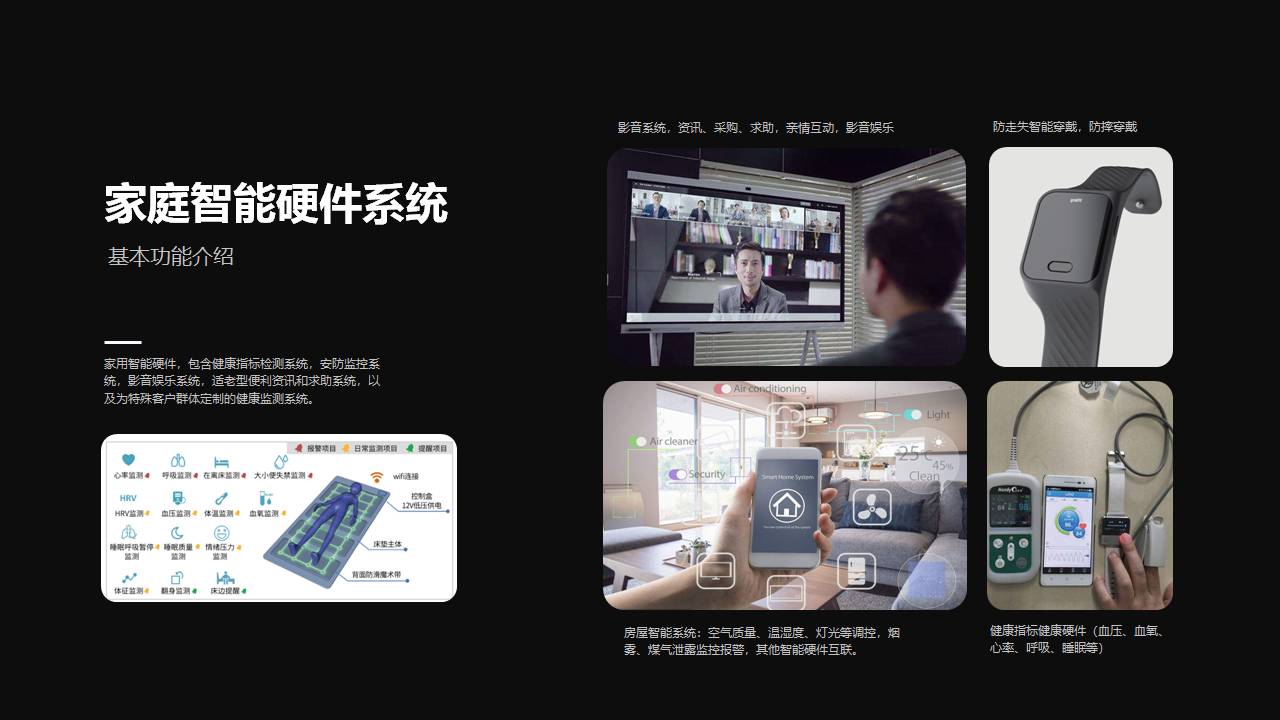
Age-friendly home adaptation, temperature, humidity and air-quality control, smoke, fire, water and gas detection, security alarms, video interaction, and appliance management.
Cleaning, nutrition planning, mobility assistance, hygiene monitoring, bathing and personal care, exercise support, therapy, and rehabilitation assistance.
Online senior education, travel, psychological support, wearables, leisure exercise, social connection, and family audio-video interaction.
Finance, insurance, legal consultation, asset management, notarization, and other professional resources connected through platform standards.
System Architecture
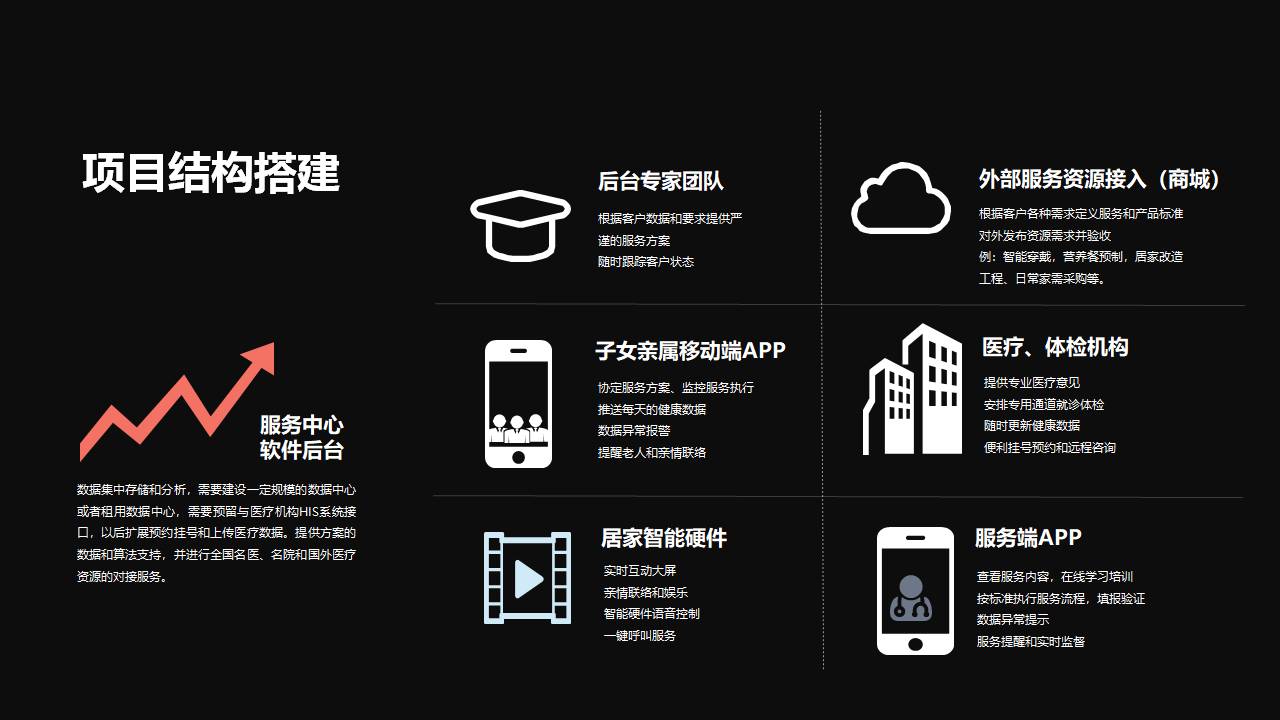
Stores and analyzes service, health, execution, and resource data while reserving interfaces for medical institutions and expert resources.
Produces care plans based on client status, health data, and service requirements, then updates them as conditions change.
The family app confirms plans, reviews data, and supports contact; the care-worker app receives tasks, follows standard procedures, records feedback, and supports training.
Connects health monitoring, interactive screens, voice control, one-touch calling, wandering prevention, and environmental safety monitoring.
Provides professional medical opinions, checkup channels, health-data updates, appointment support, and remote consultation.
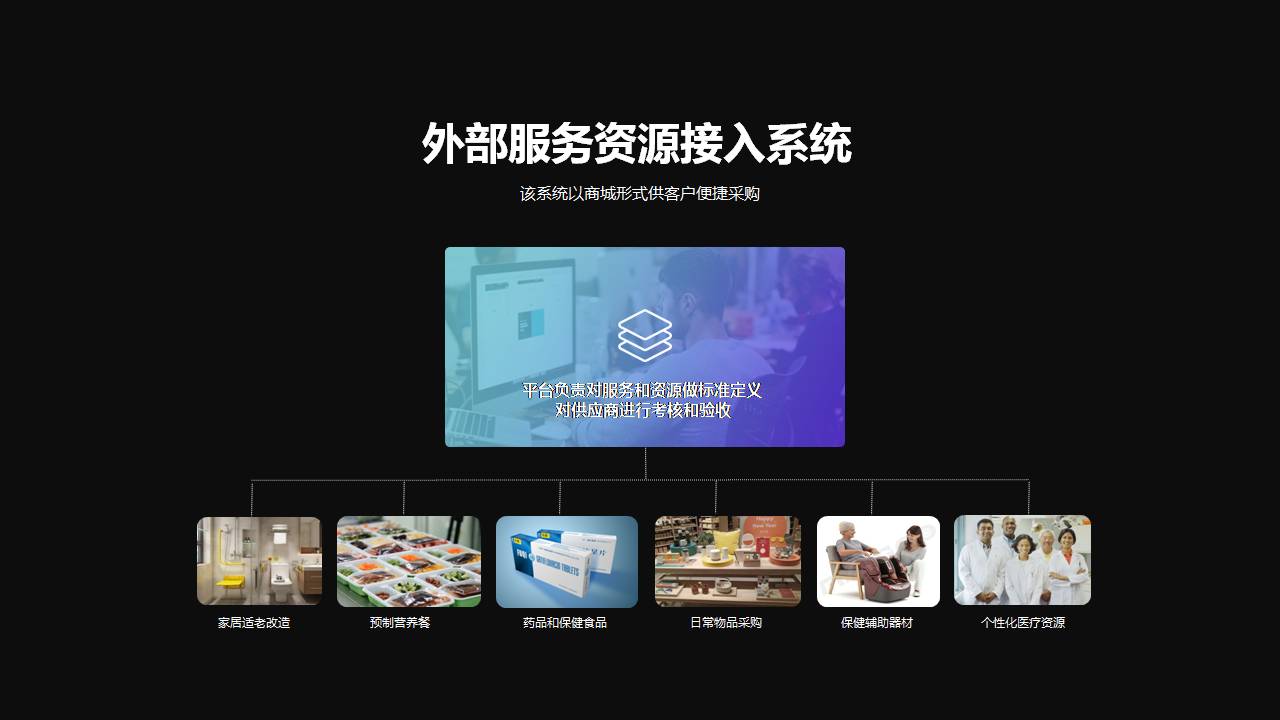
Defines service and product standards for nutrition meals, age-friendly adaptation, daily purchases, assistive devices, and personalized medical resources.
Closed-Loop Workflow
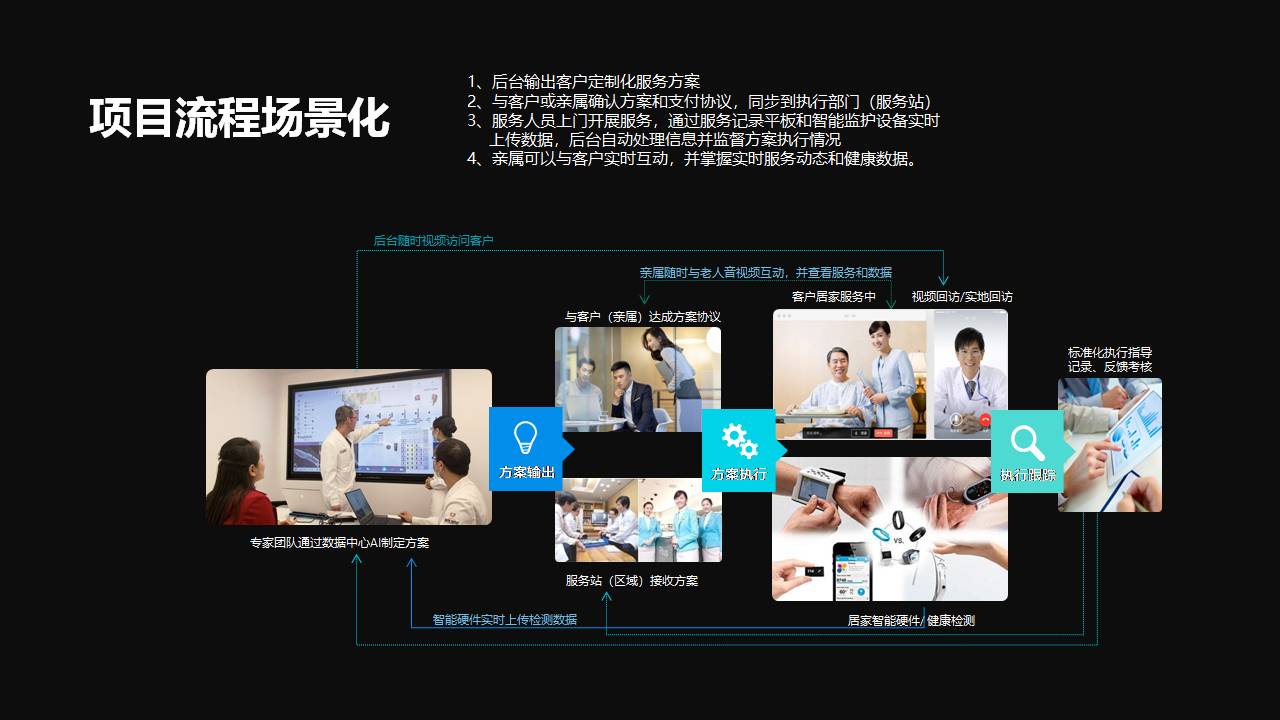
The call center transfers client information, the client center visits and profiles the client, and the data center creates an updateable data foundation.
The expert team combines health data, risk level, and service needs, using AI and rule systems to generate customized plans.
The plan and payment agreement are confirmed with the client or family and synchronized to the service station and execution team.
Care workers provide home services through standard procedures, record execution through terminals, and receive real-time uploads from smart monitoring devices.
The backend handles exceptions and supervises execution; family members can view service updates, health data, and audio-video interactions.
Home Terminal
Resource Integration
Capability Mapping
Treats vital signs, behavior, service records, and family feedback as continuous data rather than one-time service notes.
Translates expert judgment into service procedures, terminal reminders, exception thresholds, and traceable tasks.
Allocates care workers, hardware, medical support, and external suppliers according to frequency, intensity, risk, and cost elasticity.
Uses data, workflows, and resource networks to accumulate platform capability rather than relying on individual experience.
This page is reconstructed from a home-care project design document as a capability case. It demonstrates AIBIOOS thinking on lifecycle AI management, health-data loops, and service-resource orchestration. It does not constitute a launched product, medical-service commitment, care-institution qualification statement, or specific commercial offer. Real deployment would require further compliance review, medical-responsibility boundaries, staff qualification, data security, hardware certification, and regional operation validation.